10th Sep, 2025 12:00
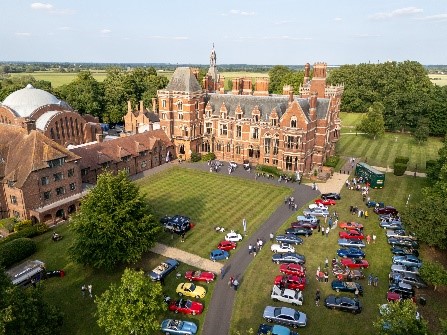
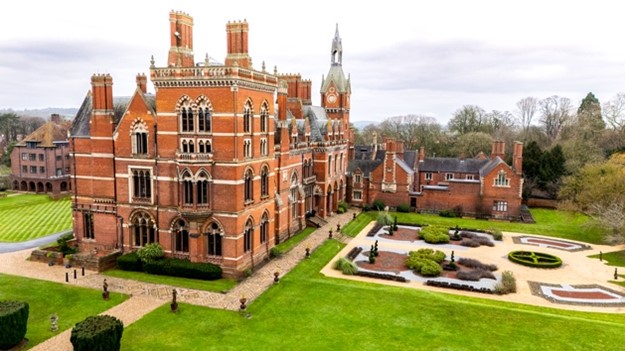
Kelham Hall | Newark, Nottinghamshire


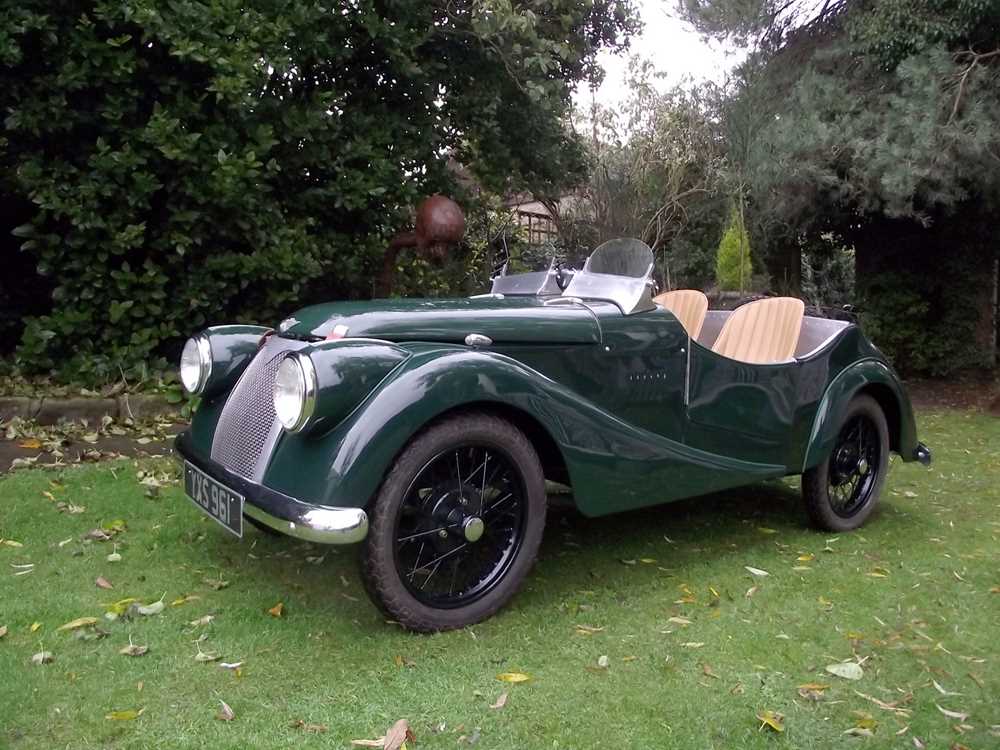
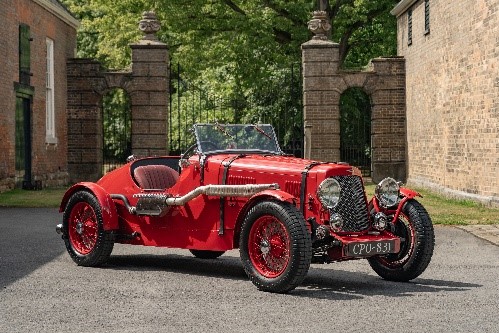
1937 Aston Martin 15/98 2-Litre 'Team Car' Evocation
Estimated at £120,000 - £150,000Registration No: CPO 831
Chassis No: A7/732/LS
MOT: Exempt
- One of just 124 15/98s manufactured
- Originally supplied with Saloon coachwork by Bertelli, before being converted to Team Car-style coachwork, reputedly in the 1950s
- Exhaustively restored to a high standard in the late 2000s and finished in Alfa Rosso Red, in emulation of the Aston Martin Team Cars of the 1930s
- Utilising a high-performance, naturally-aspirated Two-Litre racing engine built by renowned pre-war Aston Martin specialist Alan Brooke Engineering
- Eligible for VSCC competition
- Offered with a large history file including AMOC correspondence
Introduced at the 1936 Olympia Motor Exhibition, the Aston Martin Two-Litre 15/98 reflected an increasing bias among the buying public towards comfort and sophistication. Notably more refined than its predecessors, the newcomer sat on a 9ft 8in wheelbase (though later 2/4-seater and Speed Model variants utilised 8ft 3in and 8ft 6in wheelbases). Initially available with a choice of four-seater Saloon or Tourer coachwork, its rigid cross-braced chassis frame featured all-round leaf-sprung suspension, André Hartford shock absorbers, and four-wheel drum brakes. An impressive unit that would later power the marque to victory in the 1938 Tourist Trophy and 1946 Belgian Grand Prix, the model's 1950cc SOHC four-cylinder engine was credited with developing 98bhp (the ‘15’ in its 15/98 designation being the RAC horsepower rating). Fitted with a positive-throw four-speed manual gearbox, the Feltham machine was reputedly capable of over 85mph. Assembled by hand, the Two-Litre encountered various teething troubles, which saw Aston Martin slash its sales expectations. Priced at £595 and £575 depending on the body, the total production of the 15/98 in all its forms amounted to just 124 cars. As with so much pre-war coachwork, many original 15/98 bodies eventually deteriorated beyond economic repairs. Happily, however, the brilliantly-engineered chassis were often treated to a new lease of life and rebodied as much sportier Speed Models.
Before we get into the finer details of this delightfully racy Two-Litre Team Car-inspired 15/98 special, we would invite prospective bidders to imagine themselves among the spectators at the glorious RAC International Tourist Trophy race in Newtownards in 1934, witnessing the first competition foray of the new Aston Martin Ulster. The TT was the pre-eminent British sports car race of the period, and consistently attracted some of the best cars and drivers from the British motor sport scene, often with a crop of high-profile European drivers thrown into the mix. The TTs were always dramatic and often unpredictable, such as in 1931, when Norman Black drove to victory in the little 746cc MG C-type Midget, trouncing Borzacchini’s Alfa Romeo 6C 1750, which the clever money had insisted would be the winner. Between 1931 and 1936, the race was dominated by British marques, with MG and Riley claiming three wins each.
Aston Martin, meanwhile, was not an insignificant presence. Several Astons had been raced at home and abroad during the 1920s, and with frequent successes, but it was the Le Mans and Ulster racers which would really be instrumental in forging the marque’s international reputation. The first Ulsters, chassis LM11, LM12 and LM14, were evolutions of Aston Martin’s works entries for the 1934 Le Mans, taking as their basis an extensively lightened 1½-litre Mk. II chassis clothed in two-seater racing bodies. The engines were much uprated, with a stronger crankshaft, increased compression ratio, higher-lift cam, enlarged inlet valves and specially-made 13/8in SU carburettors. While the standard Mk. II produced 70bhp, the Ulster claimed an output of 85bhp and a top speed in excess of 100mph.
The Ulster’s first public appearance at the Ards Circuit in 1934 demonstrated that it was a highly capable machine. There were 40 starters but only 17 classified finishers, and no foreign marques were entered that year. Not only were all three Aston Martins among the finishers, they placed a highly creditable third, sixth and seventh – the best team result of the race. Thomas Fotheringham-Parker took the podium spot, behind Charlie Dodson’s N-type MG and Eddie Hall’s 3½-Litre Bentley, while the Lagonda M45s of Brian Lewis and Johnny Hindmarsh placed fourth and fifth. All the Singers, Invictas and V8 Fords had expired during the race and, among the finishers, the Rileys, Talbots and Frazer Nashes were no match for the Ulsters. Arguably, the best was yet to come, when Aston Martin’s three-car works team plus four privately-fielded Ulsters turned up to contest the 1935 24 Hours of Le Mans. This was once again a testament to the model’s durability, as six of the seven Ulsters completed the race, with only the works car of Penn-Hughes and Fotheringham-Parker retiring after an accident. The Hindmarsh-Fontés 4½-litre Lagonda M45 and the Heldé-Stoffel supercharged Alfa Romeo 8C 2300 placed first and second, each with 222 laps covered, but the 1½-litre Aston of Charlie Martin and Charles Brackenbury was hot on their heels, placing third with 215 laps and setting a 1½-litre distance record. The other Ulsters finished eighth, tenth, eleventh, twelfth and fifteenth.
The Ulster story may be familiar to followers of the marque, but what happened next – or rather, what didn’t – is less well-known. The 1½-litre Astons were perhaps the best sports cars in their class, but they were also the most expensive, which limited their marketability. The solution in Aston’s eyes was to increase the size of the engine and so create a competitively-priced offering in the class above. Thus was the Two-Litre Speed Model born, its début planned for the 1936 Vingt Quatre Heures. Two works racers, unofficially known as LM22 and LM23, were entered into the race, which was ultimately cancelled due to industrial action across France. The Team Cars were sold into private hands having never been raced by the works, and after that Aston Martin withdrew from competition, leaving the Two-Litre Team Cars as one of the great “what ifs” of motor racing history. LM23 appeared at the 1936 24 Hours of Spa, driven by Elwes and MacRoberts, but did not finish.
It requires no further explanation as to why any red-blooded sports-car enthusiast must surely covet an original Ulster or even one of the Two-Litre Team Cars, but since their numbers only ever reached 31 and two respectively, ownership is the preserve of the fortunate few. There is nothing to stop anyone from paying tribute to the models with a well-crafted special, however, as the constructor of this lively little 15/98 opted to do. Chassis A7/732/LS was completed in 1937 on the Two-Litre long chassis and originally equipped with grey Saloon bodywork by Bertelli and registered ‘EPG 831’. It was despatched to the celebrated sports-car dealership Cresta Motors Ltd. of Broadwater Road, Worthing, which enjoyed close connections to Aston Martin and their coachwork designer ‘Harry’ Bertelli. One of Cresta’s directors, Jim Elwes, had raced Ulster Team Cars LM10, LM12 and LM18, and Two-Litre Team Car LM23. The first known owner of 'EPG'/'CPO' surfaces in 1951, one G. V. Griffiths of Port Talbot. By 1962, it belonged to B. E. Collins of Uxbridge, and then its history is unknown until 1995, when it resurfaced in the hands of Mr. J. A. Stringer and became the subject of correspondence with Jim Young, the Aston Martin Owners’ Club’s registrar for Bertelli-era 1½- and Two-Litre models, but by 1995 it had been fitted with the bright red Team Car-style body and a Riley Big Four engine.
In the late 2000s, it was subjected to an extensive programme of renovations which saw it repainted and equipped with a race-prepared, twin-SU-equipped Two-Litre engine and a reconditioned original gearbox by renowned pre-war Aston specialist Alan Brooke Engineering. High-performance liners were installed in the steel drum brakes. The work was completed by 2012, when VSCC eligibility was reapplied for and an Eligibility Document was granted which stated that the crankcase, gearbox casing, back axle casing and front axle were all original. The document further records that the majority of the chassis components were to standard specification at the time of issue. The correct type of engine was reinstated in the 1990s, with correspondence from Mr. Young discussing compression ratios, camshaft and ignition timings, and carburettor specifics.
In spite of its VSCC eligibility ‘CPO 831’ has not been extensively used following its overhaul, although it had been raced in the early 1990s and accumulated quite a collection of trophies. Undoubtedly, it will make for a highly versatile machine should the next owner wish to test its capabilities in competition. It is potentially suitable for circuit racing, speed events and driving tests, but it is also a well-finished road-going sports car with an all-weather hood, so it should be equally at home in rallies and non-competitive tours. Needless to say, it would be very much welcome in the equivalent AMOC events, too. On the other hand, a highlight of ‘CPO’s’ recent history was its appearance at the Heveningham Hall Concours in 2018.
With its lively engine and playful stance, it is not difficult to imagine this Two-Litre Team Car tribute dicing with the best of them at Le Mans and the TT in the mid-1930s, but since that never happened, perhaps it will be incumbent upon the new owner to demonstrate just how fiercely it can compete against the contemporary Rileys, Delahayes and Lagondas. This quintessential post-vintage sports car is offered with a very large paperwork file including AMOC correspondence, VSCC documents, numerous invoices and assorted articles.
For more information, please contact:
Paul Cheetham
paul.cheetham@handh.co.uk
07538 667452
Auction: Kelham Hall | Newark, Nottinghamshire, 10th Sep, 2025
An auction of classic, collector and performance motorcars and select automobilia to be held in the beautiful surrounds of the Kelham Hall, Newark Nottinghamshire.
View the Car CatalogueView the Automobilia Listing
To join the auction in person or via the telephone, please click here for more information How to BidTo take part in online bidding please click 'Register to Bid | Sign In' at the top of the page or bid through our auction partners Saleroom.com Saleroom
Viewing
Tues 9th September from 12pm
Wed 10th September from 9am

All successful bids must be paid in full by midday the day after the auction at the latest.
You can collect your new pride and joy from our venue until 1pm the day following the sale or our partners are on hand to help arrange safe transportation:


Do you have an item to sell?
If so, contact one of our friendly specialists for your free valuation by completing the form below and someone will get back to you as quickly as possible.
If you prefer to speak to humans, don't hesitate to call our office on +44 (0)1925 210035


Other lots in this sale