15th Oct, 2025 12:00
Pavilion Gardens | Buxton, Derbyshire


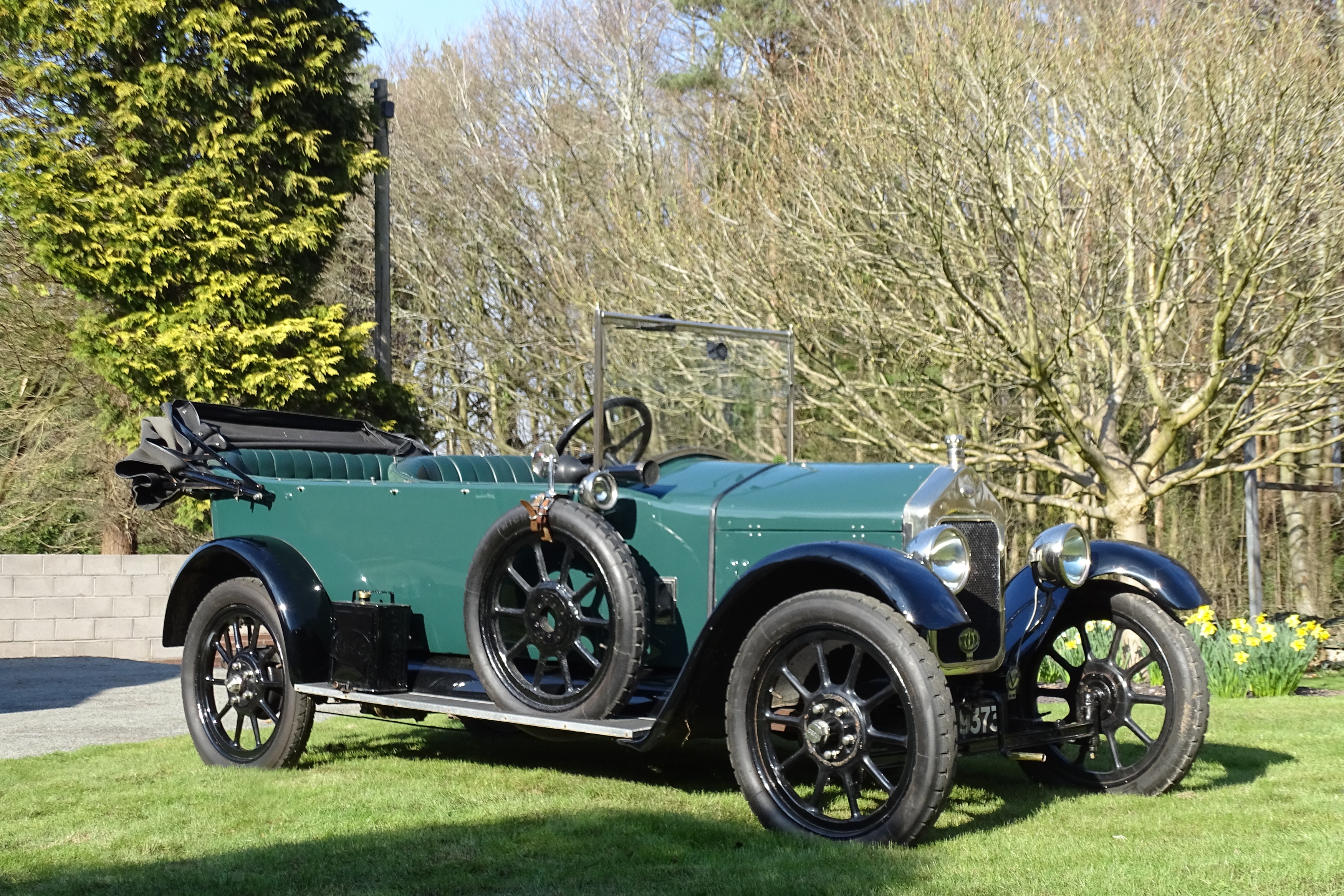
1902 Arrol Johnston 10/12hp Dogcart
Very original and one of just eight believed to survive
Sold
(including buyers premium)
Registration No: XS 2
Chassis No: 281
MOT: Exempt
- Carrying the delightful early Paisley registration ‘XS 2’
- Known to have entered one London to Brighton Run in the late 1990s
- Very original and one of just eight believed to survive
- Recently subject to some partial recommissioning
One of the famous “Three As” of Scotland’s early motor industry, along with Albion and Argyll, Arrol-Johnston was there right at the very beginning. George Johnston and Sir William Arrol established the Mo-Car Syndicate Ltd. in Bluevale, Glasgow, in 1897. Sir William was by then renowned for his civil engineering achievements, having been awarded contracts for the Forth Bridge, the second Tay Bridge and the metalwork of Tower Bridge. While Arrol-Johnston survived until 1931 (after merging with Aster in 1927), it remains best-known for its earliest products, the distinctive high-wheeled Dogcarts which were produced until as late as 1906. These were horseless carriages in the most literal sense, with solid-tyred carriage wheels and varnished four- or six-seater bodies, and, though their design was somewhat antiquated, they found plenty of willing buyers, especially in Scotland.
The Dogcart name was carried over from the carriage-building industry, where it described a two-wheeled carriage with a back-to-back seating arrangement and a compartment under the seat for gundogs. The early models appeared in 1899 with tiller steering and a rear-mounted, horizontal, underfloor engine of 5½hp, which although a single-cylinder contained two opposed pistons. From the pistons, short rods rocked levers which in turn moved longer con-rods which rotated the crank. Before long, wheel steering and a twin-cylinder (four-piston) engine were employed, giving 10hp, and from 1901 it became a 12hp, with 108 by 165mm bore and stroke. The engine was connected to a four-speed gearbox viâ a cone clutch and Renold chain primary-drive, which in turn drove the huge rear axle by a central chain. Further equipment included a low-tension magneto and a pull-start mechanism by way of a cord connected to a crank handle. The cord ran through the floorboards to be within easy reach of the driver.
These elephantine beasts of burden were rugged, torquey and low-geared, making them ideal for traversing highland gradients. Steady performers, in top gear they were said to reach 25mph. However, just eight are reckoned to survive. One feather in Arrol-Johnston’s cap was building the first car to enter the Sudan, in 1905. The six-seater Dogcart with solid wooden wheels, a sun canopy and a trailer carrying an enormous searchlight was for the use of Sir Reginald Wingate, Governor-General of the Sudan. This car was known to be among the survivors, but tragically its home, the Khalifa House Museum, has succumbed to vandalism and looting during the present Sudanese civil war. It was also in 1905 that an Arrol-Johnston won the first International Tourist Trophy Race on the Isle of Man. While that was a purpose-built 18hp racing machine of more modern and orthodox design, it retained the opposed-piston layout.
Carrying the delightful early Paisley registration ‘XS 2’ – indicating that it was the second car to be registered in Paisley – this marvellously original 1902 Dogcart is thought to have been owned originally by Sir Thomas Coats, of the family behind Paisley’s Ferguslie Thread Works. Little early history is known, but it appears the Arrol-Johnston was transferred to the Isle of Bute, placed into storage in 1919, and then discovered on the island in 1942 by Tom Lightfoot, one of the 20th century’s most prominent veteran car enthusiasts, while he was serving with the Royal Navy. It is understood that he purchased it from the Bute Ship Dock Co., and presumably kept it at his home in Epsom, Surrey. Other documents point to the ownership of Norman Cole circa 1962 and Norman Ball circa 1970, prior to its acquisition in 1998 by the late Geoffrey Plaisters. It is known to have entered one London to Brighton Run in the late 1990s, plus the 2002 Glasgow-Paisley-Dumfries Arrol-Johnston Commemoration Run. Although the Arrol-Johnston has been out of use for some time following Mr. Plaister’s death, it was recently placed on loan to the Great British Car Journey museum, which oversaw its partial recommissioning. While it has been running, it will require further attention before it is roadworthy, but what a fantastic opportunity it presents to revive and preserve such a rare and unusual veteran. It is to be sold with various technical papers, a copy of the 1902 Arrol-Johnston sales catalogue, historic photographs, and correspondence and paperwork from previous ownerships. Of the surviving Dogcarts, two are regular and reliable Brighton Runners, and another two are preserved in British museums. When this one returns to the Brighton (as it surely must), it is guaranteed to be one of the stars.
For more information, please contact:
Stewart Parker
info@handh.co.uk
07836 346875
Auction: Pavilion Gardens | Buxton, Derbyshire, 15th Oct, 2025
An auction of classic, collector and performance motorcars to be held in the beautiful surrounds of the Pavilion Gardens, Buxton, Derbyshire.Venue Details
To enquire about entering your classic or performance car into the auction please call our sales office on 01925 210035, email sales@HandH.co.uk or click here: Enter Your Classic Motorcar
All our professional valuations are complimentary and without obligation.
To join the auction in person or via the telephone, please click here for more information How to BidTo take part in online bidding please click 'Register to Bid | Sign In' at the top of the page or bid through our auction partners Saleroom.com Saleroom
Viewing
Tues 14th October from 1pm
Wed 15th October from 9am

All successful bids must be paid in full by midday the day after the auction at the latest.
You can collect your new pride and joy from our venue until 1pm the day following the sale or our partners are on hand to help arrange safe transportation:


Do you have an item to sell?
If so, contact one of our friendly specialists for your free valuation by completing the form below and someone will get back to you as quickly as possible.
If you prefer to speak to humans, don't hesitate to call our office on +44 (0)1925 210035


Other lots in this sale