18th Mar, 2026 12:00
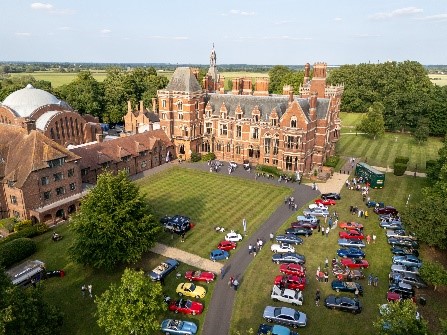
Kelham Hall | Newark, Nottinghamshire


1937 Frazer Nash-BMW 328 Roadster
No Reserve - Period competition use and family-owned since 1968
Sold for £360,000
(including buyers premium)
Registration No: DYX 612
Chassis No: 85089
MOT: Exempt
- Imported by AFN Ltd. as one of just 48 right-hand drive BMW 328s from a total production run of 464
- Potentially eligible for several of the historic motoring world's most significant events, including the Mille Miglia Storica, Le Mans Classic and Goodwood Revival
- Period competition history, including at the 1939 Welsh Rally and Lewes Speed Trials
- Saved from a state of dilapidation by the current lady owner and her late husband in 1967
- Lovingly restored immediately after acquisition and enjoyed for both competition work and Continental touring holidays over the next fifty-odd years
- Currently fitted with a Bristol engine, gearbox and back axle, but supplied with the correct original BMW components
"The BMW 328 is legendary. It is acknowledged by car enthusiasts the world over as having a special pedigree, presence and uniqueness. It is definitively among the most attractive, successful and influential sports cars ever built."—Rainer Simons, BMW 328: From Roadster to Legend
Débuting not on a glittering motor show stand but at a rain swept Nürburgring, the BMW 328 still caused a sensation. Entered for the Eifel Trophy Sports Car Race on June 14th, 1937, and piloted by world motorcycle record holder Ernest Henne, the prototype (chassis 85001) left more than just its Bugatti and BMW 319/1 class opposition floundering. Die Motorwelt commented that "Henne got something incredible from his 2-litre car... He rockets away, down the long straight and into the bends and sweeps of the 'Ring... his sports car is faster than the entire supercharged competition! Henne is far superior from the start to his victorious finish." Designed and developed in a little over twelve months, the Type 328 was the brainchild of Fritz Fiedler and Rudolf Schleicher. The ultimate expression of BMW's contemporary Leichtbau (lightweight construction) philosophy, the newcomer was built around a tubular A-frame chassis. Notably rigid, the patent-protected structure consisted of two large-diameter side members and three rectangular cross members. Equipped with independent transverse-leaf front suspension, a well-located 'live' rear axle and rack-and-pinion steering, advances over its Type 319/1 predecessor included improved telescopic shock absorbers and hydraulically operated 280mm drum brakes.
Charged with extracting more power from BMW's existing 1,971cc straight-six engine, Rudolf Flemming devised an ingenious aluminium-alloy cylinder head that housed hemispherical combustion chambers and symmetrically inclined valves (at an 80deg. angle) but without the need for double overhead-camshafts. Instead, the Type 328's crankcase-mounted camshaft managed both the inlet and exhaust cycles; the former by a conventional pushrod and rocker action and the latter viâ bell cranks controlling additional shorter pushrods which spanned the head and contacted a second set of rockers. Initially quoted as developing 80bhp at 4,500rpm, the resultant powerplant had great tuning potential (as well as forming the basis of a post-war Bristol engine that continued winning top-flight races into the 1960s). Mated to a compact ZF AK-S15 four-speed manual gearbox and driving the rear wheels viâ a 'light' 3.88:1 rear axle, it delivered 100mph performance (a larger Hurth transmission and 'heavy' 3.7:1 rear axle were adopted from chassis 85281 onwards). Bodied in a mixture of steel and aluminium over a wooden frame, the Type 328 was styled under Peter Szymanowski, BMW's head of bodywork design.
Blending elegance with modernity, the Type 328 sported a svelte 'double kidney' radiator grille, semi-recessed headlights, cutaway doors and tapering wings, not to mention a pinched waist, two-piece windscreen, disappearing hood and sunken spare wheel well. Riding on Kronprinz 'quick release' 16in. disc wheels and boasting a kerb weight of just 1,720lbs. (with 50 litres of fuel aboard), it did not become publicly available until February, 1937. An outstanding competition car, the two-seater enjoyed success on events as diverse as the RAC Rally (1st 1939), Mille Miglia (class win 1938, 1st overall 1940) and Le Mans 24 Hours (class win 1939). Indeed, its first four seasons saw the sports car notch up an incredible 141 victories from 172 national and international starts. The Bavarian Motor Work's British agent since November, 1934, AFN Ltd. ensured that forty-six out of the forty-eight right-hand drive cars made were supplied as Frazer Nash-BMWs (total Type 328 production amounted to 464 units). The prime mover behind AFN Ltd., H. J. Aldington contributed more than his fair share of race results to the model's competition pedigree; a task in which he was ably assisted by fellow Frazer Nash shareholder and racing driver A. F. P. Fane (both racing for the works on several occasions). Today, the BMW Type 328 is eligible for such prestigious events as Le Mans Classic and the Mille Miglia Storica. One of the most rewarding yet least punishing pre-war sports cars to drive, the design has long been acknowledged as an all-time great.
Our car, chassis 85089, has an outstanding history. Having seen some competition use before the war, it led a highly active post-war life, especially with the present family, which acquired it as a wreck in 1967. Its entry in the AFN Ltd. sales ledger reveals that it was despatched on July 16th, 1937, through Eustace Watkins Ltd., to Captain A. Grant of Carron, a remote village in the wild and windswept Scottish highland region of Strathspey. Captain Grant will make a fascinating figure for further research, as we note that Clan Grant has been the foremost land-owning family in the Spey Valley for generations, with its genealogy traceable back to the twelfth century.
All we know about our Grant is what was uncovered by historian Donald Cowbourne, which is that he participated in the 1932 R.S.A.C. Rally in an MG Magna. We know no other records of him participating in competitive driving, but a photograph said to date from 1937 or ’38 shows ‘DYX 612’ at a race alongside another 328, ‘GMC 1’; famously of the legendary Frazer-Nash racer, A.F.P Fane. Certainly, Grant drove the 328 pretty far and hard, as there are copious entries in the sales ledger for maintenance and mechanical repairs up to September, 1938. The entry from November 1st, 1937, reveals that, in under four months, the BMW had covered 7,755 miles.
The next owner was K. N. Smith, by no later than the summer of 1939. He was a more active rallyist, with Cowbourne’s research revealing that he participated in the 1936 R.A.C. Rally and 1937 Welsh Rally in a closed Triumph, before tackling the 1938 R.A.C. and R.S.A.C. Rallies, plus the 1939 R.S.A.C., in a Frazer Nash-BMW 319/1, registration ‘EGH 904’. The 1938 Welsh and 1939 R.A.C. were tackled in a ’Nash-BMW of unconfirmed identity (assumed to be ‘EGH’), but he definitely drove ‘DYX’ in the 1939 Welsh Rally in July. As the R.S.A.C. Rally had been in May, it is possible that Smith’s entry in the Blackpool Rally in June was also with ‘DYX’.
Alas, Smith’s Welsh Rally was not all it might have been. After starting from Stratford, he reached the overnight halt at Porthcawl. The following morning, 85089 remained in the car park long after the other competitors had disappeared. A picture and accompanying caption appeared in The Motor, suggesting Smith enjoyed a bit too much sauce the night before. Louis Klemantaski captured the car on the start line at the 1939 Lewes Speed Trials, which also took place in July, with the driver assumed to be Smith; his photograph was printed in Denis Jenkinson’s BMW 328 Profile Publication.
The BMW’s life during the war years is not well-documented, but we are fortunate to know its entire post-war history. From May, 1946, it resided with David H. Bloomer, who lived in the centre of Grimsby, and its colour was recorded as Silver Grey. From July, 1947, it belonged to J. Blake & Co. Ltd., whose address was in the centre of Liverpool. It was surely no coincidence that a manager of J. Blake was Frankie Penn, whose interest in racing sports cars led to him becoming the northern correspondent of Autosport after it was founded in 1950. The BMW was sold in February, 1950, to E. M. (Mark) Reaston, in the historic heart of York. He kept it until 1958, though between May, 1950, and March, 1951, the logbook shows the Eclipse Copper Co. (York) Ltd. as the owner. Indeed, Reaston owned Eclipse. The final entry in the logbook named Alan Mountain of Acomb as the owner from July, 1958, but once he took over no further licence stamps were issued.
During this period, 85089 saw action in B.A.R.C. race meetings in the North. Mountain was one of Reaston’s employés, and had borrowed the 328 for a race at Croft. He ran well for a time, then was aghast to see the bonnet detach itself and fly over his hand, only to crash-land and get run over by the car following. He spent the next Sunday with some workmates at the Eclipse workshop, forming a “somewhat ill-fitting” replacement.
Although never registered in his name, the next owner was David Harrison, whose father ran a major contractors’ firm in Pudsey. Harrison also owned and raced the Alvis-engined Frazer Nash Norris Special; his mechanic was a well-known figure known as “Harrogate Jack” Laing, and it appears he gifted the 328 to him, perhaps in lieu of payment for work. Finally, the late Guy Smith entered the picture, after buying the Alvis-’Nash from Harrison for £415 in 1966.
Guy and his wife-to-be hankered after a 328, and he wrote how his acquisition of 85089 came about: “David lived in lkley, and amongst his business interests was the tatty White Rose Garage, on the northern outskirts of Leeds. When I went to collect the car, Harrogate Jack could not initially find the drive chains, but soon remembered where they were, and said “Come with me.” We went to a small housing estate near Harrison’s works at Pudsey, where Jack lived. At the bottom of a steep gravel drive was ‘DYX’. Gravel had washed down this drive, and settled underneath the BMW up to its axles. The local kids used to play in it, and had broken all the instruments virtually beyond repair. The chains for the ’Nash were in the passenger footwell. I took more than a passing interest in the car, but Jack said it was not for sale, and, having bought the ’Nash, I had no more money.
“David had a number of Alvis engine spares which I could not afford at that time. Harrogate arranged for me to collect the Alvis engine spares from a secret workshop inside Harrison’s stores, when nobody else was around. My wife-to-be came, and chatted up Harrogate about the 328. He had many people trying to buy the car, but to use his own words, he ‘distrusted those b—y southerners.’ To cut a long story short, Harrogate so approved of the way I had rebuilt and driven the ’Nash in competition, that he relented, and sold the 328 to my wife for £212 10s. This was in the early winter of ’67.”
There followed a major restoration until the BMW was ready for the road in 1970, and that summer it took the Smiths to Northern Italy. The next year they went to Germany, and in 1972 participated in the second historic Mille Miglia. Their attitude was that, since they had the Alvis-’Nash for racing, the BMW 328 should be their Continental tourer, though it saw action at the Harewood Hill-Climb in 1974, when its 58.34sec. ascent made it the winner of Class D, beating an Alvis-Riley special, a Lagonda LG45 and an Alvis Firebird. In one European trip, they managed to get from Rotterdam to south of Naples in two days, and they often camped, the 328 having just enough room for the essentials for a two-week holiday al fresco. It was not uncommon for it to cover 3,000 miles a year, until a second bodywork restoration was started in 1996. Then, an overhaul of the original, matching-numbers 328 engine conducted between Brian Taylor and Stuart Baxter took place between 1999 and 2007, although by that stage the 328 had been fitted with a BMW-derived Bristol engine, so it still saw occasional use until it was eventually taken off the road in 2013.
Now looking for a new owner to undertake some sympathetic recommissioning, this splendid 328 is offered for sale for the first time in almost sixty years. The 1990s restoration remains very well-preserved, and, with the original BMW engine or the Bristol engine to choose from, it promises to live up to Guy Smith’s assertion that “Apart from either a Monza or 2.9B Alfa Romeo, I firmly believe the BMW 328 is the best and most practical pre-war grand touring car.” Chassis 85089 is both well-presented and extremely well-provenanced, and is supplied with much paperwork including the V5C, the 1970 green logbook, a photocopy of the 1946 buff logbook, M.O.T.s from 1970 to 2012, a 1938-39 Frazer Nash-BMW catalogue, correspondence, photographs, invoices from the engine overhaul, the Profile Publication, a workshop manual for the Bristol two-litre drivetrain, plus assorted magazines and cuttings with articles pertaining to the 328.
We are indebted to Mark Garfitt and the BMW Historic Motor Club for their help compiling this listing.
For more information, please contact:
Lucas Gomersall
lucas.gomersall@handh.co.uk
07484 082430
Auction: Kelham Hall | Newark, Nottinghamshire, 18th Mar, 2026
A live auction of classic, collector and performance motorcars to be held in the beautiful surrounds of the Kelham Hall, Newark Nottinghamshire.
Thinking of Selling?
We're now inviting entries for to our upcoming auctions. If you’d like to enter your car, please contact our sales team:
📞 Call: 01925 210035 📧 Email: sales@HandH.co.uk
🔍 Or click the Get A Valuation button – our valuations are free, with no obligation.
VENUE INFORMATION GET A COMPLIMENTARY VALUATION
Ways to Bid:
👤 In person ☎️ Bid by Telephone
💻 Bid Online or by commission, please click 'Register to Bid | Sign In' at the top of the page or through our auction partners Saleroom.com SALEROOM.COM
Viewing
Tues 17th March from 12pm
Wed 18th March from 9am

All successful bids must be paid in full by midday the day after the auction at the latest.
You can collect your new pride and joy from our venue until 1pm the day following the sale or our partners are on hand to help arrange safe transportation:


Do you have an item to sell?
If so, contact one of our friendly specialists for your free valuation by completing the form below and someone will get back to you as quickly as possible.
If you prefer to speak to humans, don't hesitate to call our office on +44 (0)1925 210035


Other lots in this sale




.jpg)